Short answer
Dropshipping is still worth it if you treat it as a marketing business, can afford to lose $400 to $1,250 learning, and choose products priced at 2.5 to 3 times their landed cost. It is not worth it if you need income within a month or expect passive profit.
Key takeaways
- Budget roughly $400 to $1,250 to get a real answer on one product.
- Ad cost per purchase, not product cost, decides most outcomes.
- Price at 2.5 to 3 times landed cost or the math rarely works.
- Set a loss limit before you spend anything.
That answer sounds hedged because the honest one is. The model works; the default way it is taught (cheap gadget, generic store, broad ads) mostly doesn't anymore. This chapter shows the math so you can decide with numbers instead of screenshots of someone else's dashboard.
In this chapter7 sections
Why this chapter matters
- Margin decides everything downstream. A product without room for ad costs cannot be saved by a better store.
- Setting a loss limit before you start is what separates a cheap lesson from an expensive habit.
- You'll know which parts of the old playbook still work and which are now traps.
What tools do you need for this step?
Prices checked November 2026. Estimates are marked as ranges.
What changed since the dropshipping boom?
The 2015-era version of dropshipping ran on three advantages: cheap social ads, shoppers who didn't yet recognize marketplace products, and long delivery times nobody had learned to complain about. All three have eroded.
- Shoppers can check. A reverse image search or a quick look on AliExpress or Amazon reveals the same item at a fraction of the price. Your page has to sell something the listing doesn't: curation, better photos, a bundle, faster delivery, support.
- Ad platforms are pickier. Meta reviews ads and pages, penalizes poor buyer feedback, and new ad accounts often start with spending limits. Cheap, misleading creative gets caught faster.
- Delivery expectations are higher. Two-week shipping on an impulse buy now drives refunds. Many sellers move winners to faster US or EU stock once a product proves itself.
What hasn't changed: you can still test whether people want a product without buying a pallet of it. That is a real advantage, and it is the reason this course exists.
How much does it cost to start dropshipping?
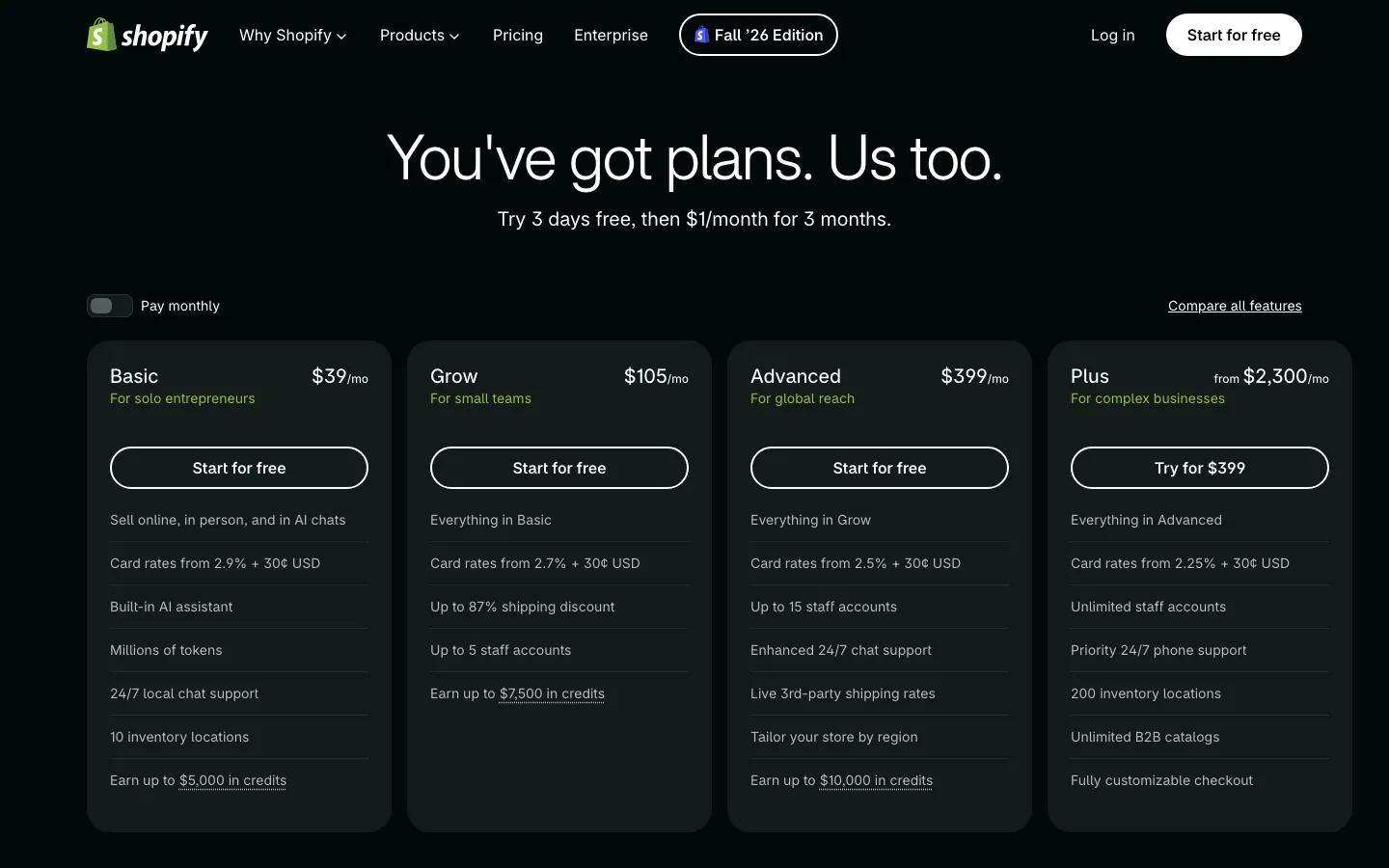
Shopify's pricing page lists the Basic plan at $39 a month, or $29 a month billed yearly, with card rates from 2.9% + 30¢ on Basic. New stores currently get a short trial: three days free, then $1 a month for three months.
A realistic first-test budget, assuming you build the store yourself:
| Item | Estimate | Notes |
|---|---|---|
| Store plan, first 3 months | $3 to $120 | Depends on whether the $1 offer applies to you |
| Domain | $10 to $20 | Per year |
| Apps | $0 to $50/mo | Start with free tiers |
| Samples | $30 to $80 | Order 2 to 3 candidate products |
| Ad testing | $300 to $1,000 | The part that decides whether you learn anything |
| Total to a real answer | About $400 to $1,250 | Estimate; ads dominate |
How much profit does one sale make?
Here is a worked example with round, plausible numbers; swap in your own. The point is the shape: product cost rarely kills a store. Ad cost per sale does.
One $40.00 order
Worked example
- Landed product cost
- $14.00
- Card fees (2.9% + 30¢)
- $1.46
- Refund allowance (5%)
- $2.00
- Ad cost per purchase
- $15.00
- What you keep
- $7.54
1. Landed cost
Supplier price plus shipping to the customer. In this example, $11 + $3 = $14.
2. Payment fees
2.9% + 30¢ on $40 is $1.46 on Shopify Basic with Shopify Payments.
3. Refunds and replacements
Budget a slice of revenue. 5% ($2) is a reasonable starting assumption; track the real figure.
4. Ad cost per purchase
What you spend on ads, divided by the number of orders. It moves the most. Chapter 6 turns it into a break-even ROAS.
Is dropshipping worth it for you?
Dropshipping rewards people who enjoy testing, writing, and looking at numbers every day. It punishes people who need it to work. Skip it, or wait, if any of these are true:
- You can't afford to lose your test budget entirely.
- You want income within a month or two.
- You won't answer customer emails within a day.
- Your plan is to find a "winning product" and copy someone else's ad.
If you're still in, write down a loss limit now: the total you will spend before stopping to reassess. Then move on to finding a dropshipping niche and your first product.
What mistakes should you avoid?
Pricing from the supplier cost up
Start from what the customer would pay and what an ad costs, then check whether the product fits under that.
Ignoring refunds and fees
Small percentages add up fast on low-price items. Put them in the spreadsheet from the first day.
No loss limit
Without one, "one more test" becomes the plan. Decide your stop number before you spend anything.
What else do beginners ask?
How much does it cost to start dropshipping?
Our estimate is about $400 to $1,250 for a first real test: a Shopify plan, a domain, two or three samples, and $300 to $1,000 of ads. Ads are most of it.
How much do dropshippers make?
There's no honest average; most first tests lose money. In our worked example, a $40 sale with $15 of ad cost leaves about $7.54, roughly 19% of the price.
Is dropshipping saturated?
Generic products sold with copied ads are. Stores that pick a specific buyer, show real photos and promise honest delivery times still have room.